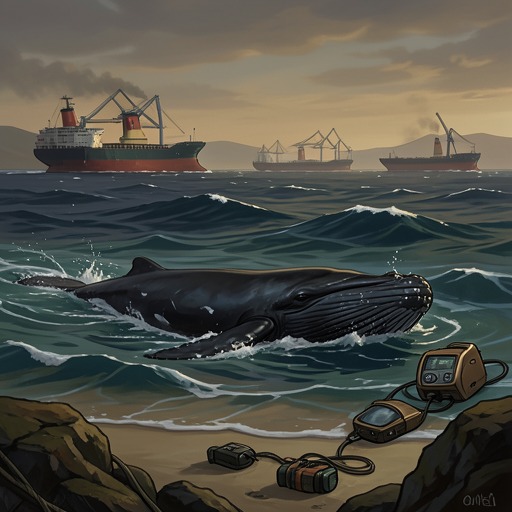
North Atlantic right whale
The WhaleThe North Atlantic right whale is at once a creature shaped by coastal waters and a record of what human exploitation has done to them. Its body and habits once made it an unusually accessible target for whalers; those same habits now expose it to busy shipping routes and fishing gear. The account follows the species from its distinctive form and history of use to the narrow prospects for its survival, while showing how the work once directed at capturing whales has been adapted to rescue them.
Identity and Coastal Habitat
The North Atlantic right whale, also called the Biscayan whale, is identified in the book as Eubalæna glacialis. It is described as lumbering and low, with a glossy body, paddle-shaped flippers, a broad mouth lined with baleen, and raised callosities. The description holds together two apparently contrary impressions: the animal can seem grotesque in the old engravings through which it was once represented, yet its unusual form is also presented as wondrous. Its arched profile and rounded shape are linked to the word whale, traced in the text to Scandinavian roots meaning arched or vaulted.
The species remains in Cape Cod Bay, part of the coastal range that makes it conspicuous in places where people and vessels are numerous. It is called an urban whale because it tends to keep close to shore. This proximity is not a minor detail of its habitat: it has helped make the whale accessible to hunters over centuries, and now places it alongside some of the busiest shipping routes. The larger ocean may be vast and difficult for people to know, but the right whale’s coastal presence brings it into direct contact with human traffic.
The book distinguishes the North Atlantic species from the Southern right whale, Eubalæna australis, and the North Pacific right whale, Eubalæna japonica. Its focus, however, is the North Atlantic population and the particular danger created by its overlap with inhabited coasts and working sea lanes.
A Body Made Vulnerable by Use
The right whale’s common name carries an economic history. It was considered the right whale to catch: its abundance of blubber made it valuable, and its buoyancy meant that it floated after being killed. Those traits made the animal easier for whalers to exploit. Its long baleen added another source of value. When heated, the pliable material could be shaped into umbrella ribs, corset stays, and venetian blinds, or used to make brush bristles. In the economy of whale products, baleen served a role comparable to plastic, and harvested plates could be gathered in bundles taller than a person.
The species was among the earliest whales hunted, including by Basque whalers in the Bay of Biscay. The book treats this history not as a remote prelude to modern conservation but as a force still visible in the population’s present condition. The right whale’s commercial usefulness arose from physical characteristics that also constrained its prospects once hunting intensified. Its coastal habits made it easier to find; its body supplied materials people wanted; and centuries of capture left the species drastically reduced.
Population Decline and Continuing Risk
Fewer than 400 North Atlantic right whales remain in the account’s estimate. The species became the first cetacean protected from hunting, in 1935, but the protection has not brought clear recovery: its numbers have remained static. Shipping rules moved the shipping lane farther north and instructed vessels to keep 500 yards from whales, yet ship strikes continue to threaten the population. The contrast is stark: legal protection can restrict deliberate hunting, but it cannot by itself remove danger from the routes and activities that intersect the whales’ habitat.
The species’ reproductive capacity offers another contrast. The book describes the right whale as highly fertile, but reports only eight remaining matrilineal lines in the northern population, a legacy of centuries of whaling. The number of surviving lines makes the damage more than a matter of total headcount: a small population may also have a severely narrowed inheritance of maternal descent. The account warns that the species’ restricted gene pool makes survival through the century uncertain. Its biological capacity to reproduce does not erase the accumulated effects of hunting and present-day hazards.
The whale’s own way of avoiding predators also becomes a liability around modern vessels. It may remain silent and still at the surface, behavior that can cause an orca to mistake it for an inanimate object. A freighter, however, does not make that distinction. The passage’s irony is that a behavior effective in one relationship with the sea offers little protection against human machinery moving through the same waters.
Rescue and the Changed Work of Whaling
Stormy Mayo first saw a right whale as a sixteen-year-old fishing on Stellwagen Bank with his father, when the animals were already close to extinction and people knew little about where most of them could be found. His early interest became a conservation career. In 1976, he helped found the Center for Coastal Studies in Provincetown and began collecting data on right whales. He later became the first person licensed by the government to rescue whales entangled in fishing line. The scale of the problem is substantial: more than 60 per cent of right whales have been caught in fishing line, while vessel strikes also kill animals, including females of calf-bearing age.
The rescue work reverses the purpose of older whaling techniques. Responders approach an entangled whale in a rigid inflatable boat and attach sea anchors to slow its movement, adapting a method once used by whalers and by Native Americans hunting whales. Mayo, wearing protective equipment and using a camera to document the operation, cuts through the fishing line with a long-handled hook. The equipment and intention have changed, but the practical encounter remains close to the one that defined the hunt: a small boat beside a powerful whale, with people trying to manage the animal’s movement. Here, however, the hook is used to release rather than capture.
The stakes are especially high for breeding females. Because so few breeding whales remain, saving a single fertile female could affect whether the population survives. Rescue therefore becomes more than an individual intervention: it is an attempt to preserve the possibility of future generations in a population already narrowed by historical exploitation.
Significance in the Book
The right whale’s story turns the old whaling label right whale to catch into an indictment of the conditions that made it a target. Its buoyancy, nearshore habits, and useful baleen first appear as practical advantages to hunters; in the present, the same closeness to human activity makes the species vulnerable in a different way. Protection has changed the law and the work of people who approach whales, but the continued danger of entanglement and ship strikes shows that conservation is not secured by a single prohibition.
The account also places the species within a wider warning about extinction. While the book was being written, the Yangtze River dolphin was declared extinct; it suggests that the right whales of Cape Cod Bay could face the same fate. The whale becomes an early warning of how harm can accumulate without a single decisive moment: commercial capture reduces populations over time, and modern hazards continue to take their toll even after hunting is prohibited. Against that history, the rescue work led by Stormy Mayo does not promise a simple reversal. It marks a change in human purpose, while the uncertain future of the North Atlantic right whale shows how much damage that change must still overcome.